
Water Leakage Detection System Installation - Server Rooms, Data Centres & Critical Spaces - Gujarat
Fire Systems Pvt. Ltd. is a leading security & safety contractor in Gujarat. We design, install, test, and commission high-reliability water leak detection systems (WLD) including sensing cables, spot detectors, alarm panels, and automatic valves in compliance with international data centre standards (TIA-942).
What Is a Water Leakage Detection System?
A water leakage detection system continuously monitors a defined area for the presence of water - detecting leaks, condensation accumulation, pipe bursts, or cooling system failures before they cause damage to electronic equipment, infrastructure, or structural elements. In server rooms and data centres, even a small water leak reaching IT equipment can cause catastrophic equipment damage, data loss, and service disruption that far exceeds the cost of the detection system itself.
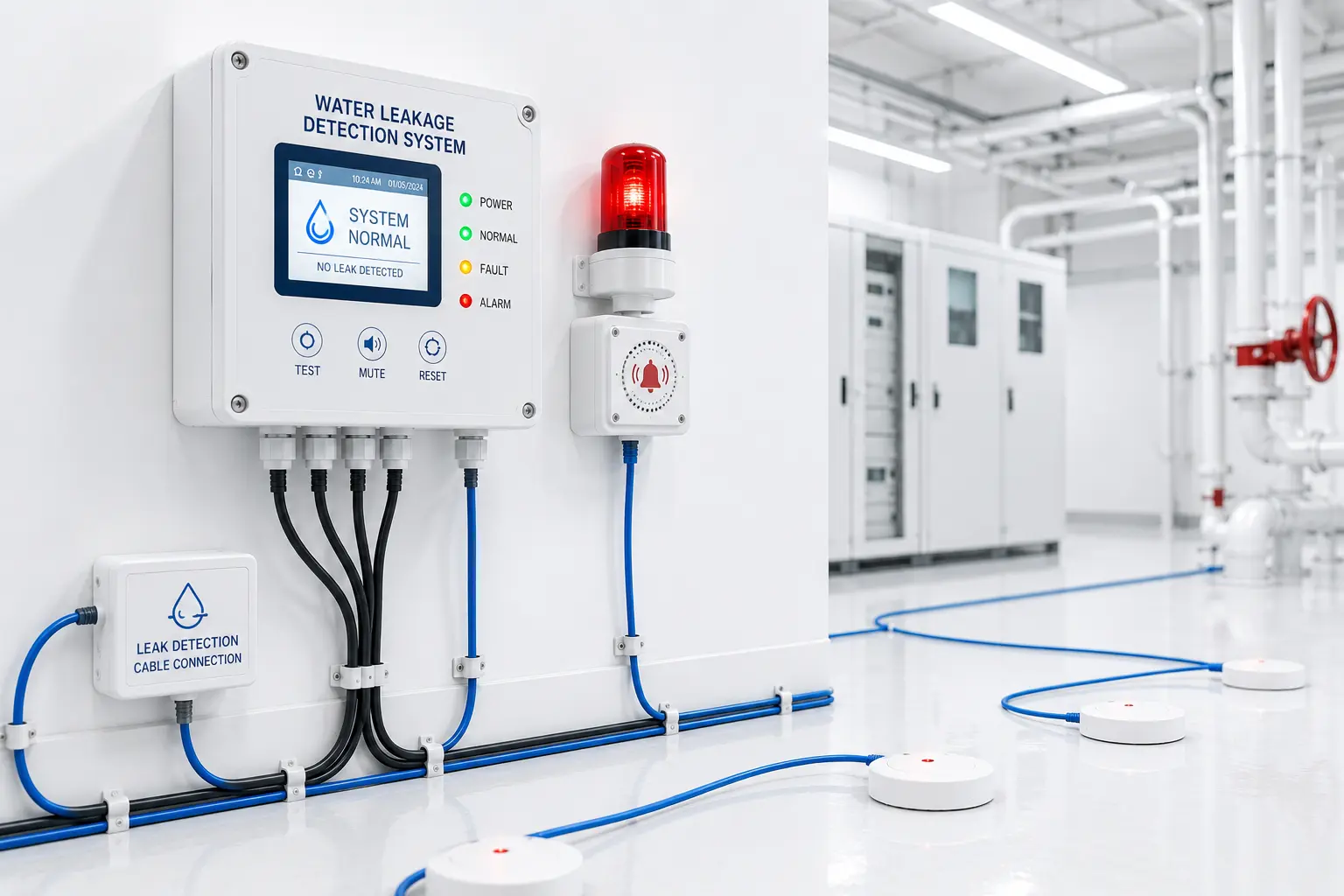
Types of Water Leakage Detection Technology
We deploy a variety of water leak detection technologies based on the room size, equipment layout, and risk vulnerability:
| Type | How It Works | Coverage | Best For |
|---|---|---|---|
| Sensing cable (zone cable) | Conductive cable - water contact changes electrical resistance | Linear - per metre of cable | Raised floors, cable trays, perimeter, pipe runs |
| Spot detector | Point sensor - water contact triggers alarm | Point location | Under precision cooling units, below critical equipment |
| Sensing rope (washable) | Conductive rope - reusable after drying | Linear - flexible routing | Tight spaces, under equipment, around pipes |
| Flood barrier sensor | Water presence at single point | Point | Data centre perimeter, critical low-point locations |
Where Water Leakage Detection Is Critical
Early warning water leak detection systems are essential in areas containing high-value electronics, critical utility piping, or moisture-sensitive materials:
Raised Floor Server Rooms
Cooling water lines, chiller connections, and condensate drain failures accumulate in the under-floor void and remain invisible until critical damage occurs.
Data Centres
Precision air conditioning units (CRACs/CRAHs), chilled water distribution pipelines, and overhead water/condensate routing paths.
UPS & Battery Rooms
electrolyte leakage, condensation, or plumbing leaks threatening high-density backup power blocks and critical switchgear.
Roof-Level Plant Rooms
Cooling towers, chillers, header pipes, and pump sets prone to corrosion, joint wear, or gasket failures, leading to leaks into floors below.
Healthcare Facilities
Sterile storage areas, pharmacy labs, and MRI machine suites where water ingress threatens clinical safety and high-cost medical scanners.
Archival & Library Vaults
Irreplaceable physical documents, legal papers, museum artifacts, and media master reels vulnerable to humidity or direct water contact.
Basement Electrical Rooms
Groundwater ingress, structural wall seepage, and sump pump backflows threatening main service panels, transformers, and distribution gear.
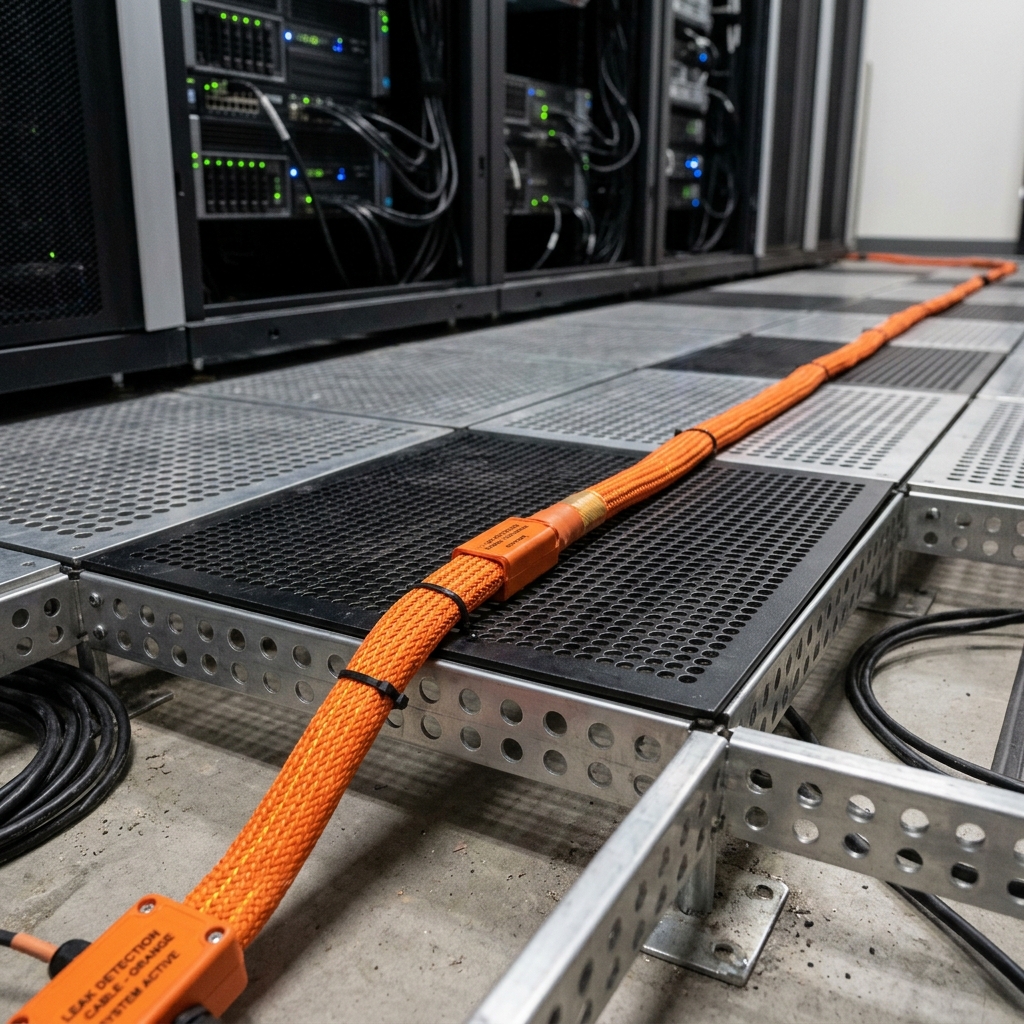
Sensing Cable System - How It Works
Sensing cable consists of two inner conductors wrapped in a water-absorbing polymer braid. In dry conditions, the resistance between conductors is very high. When water contacts the cable, the polymer absorbs moisture, reducing the resistance between conductors. The monitoring panel detects this resistance change and triggers an alarm - with the panel calculating the distance to the leak along the cable (zone or specific location depending on system type).
Integration with BMS & Monitoring Systems
Water leakage detection controllers provide relay outputs that integrate with building management systems (BMS), fire alarm panels, and remote monitoring platforms. This allows leakage events to be annunciated at a central monitoring station, generate automatic alerts via email or SMS, and trigger isolation of affected cooling circuits or power supplies.
Frequently Asked Questions - Water Leakage Detection
Find answers to common queries about sensing cables, spot sensors, and monitoring integrations for critical facilities:
There is no specific Indian standard mandating water leakage detection in server rooms, but it is strongly recommended by data centre design standards (Uptime Institute Tier standards, TIA-942) and required by many insurance underwriters for Tier III and above data centres. For any server room with chilled water cooling, it is considered essential infrastructure.
Sensing cable provides linear coverage along its length - any water contact at any point along the cable triggers an alarm. It is ideal for perimeter protection and under-floor coverage. Spot detectors cover a single point - they are simpler and lower cost, suitable for monitoring specific high-risk points such as directly under a precision cooling unit or below a known pipe joint.
Standard sensing cable (non-washable type) should be replaced after a significant leak event, as water absorption may affect long-term sensitivity. Washable sensing rope (conductive rope type) can be rinsed, dried, and returned to service. We specify the appropriate type based on the installation environment.
A standard server room water leakage detection installation (sensing cable under raised floor + spot detectors under CRACs) typically takes 1–2 days. Larger multi-floor data centre installations are designed and executed in phases.
Yes. Water leakage detection controllers provide dry contact relay outputs that integrate with any BMS that accepts digital inputs. Modbus RTU/TCP integration is available on some controllers for deeper BMS integration. We assess your BMS platform before specifying the integration method.
Prevent Catastrophic Server Room Water Damage
We serve Ahmedabad, Surat, Vadodara, Rajkot, Gandhinagar, and all of Gujarat. Contact us today for a free design layout, technical specs, and installation quote.
Schedule a Site Survey
Get a custom under-floor layout recommendation and equipment list designed specifically for your critical space by safety experts.
Response within 24 Hours · Zero Obligation