
Fire Alarm System Installation in Ahmedabad, Gujarat & Across India
Fire Systems Pvt. Ltd. is a specialist fire alarm system contractor based in Ahmedabad, Gujarat. We design, supply, install, test, commission, and maintain conventional and analogue addressable fire alarm systems for industrial plants, commercial buildings, hospitals, warehouses, data centres, educational institutions, and residential complexes. Every installation we deliver is designed in compliance with IS 2189 and the National Building Code (NBC) 2016, Part 4 - and documented for fire NOC submission to Gujarat Fire & Emergency Services.
What Is a Fire Alarm System?
A fire alarm system is an active fire protection system designed to detect the early signs of a fire - smoke, heat, or flame - and alert building occupants through audible and visual warning devices so they can evacuate safely. In larger buildings, the system also signals a central monitoring station or building management system to trigger a coordinated emergency response.
Under Indian law and the National Building Code 2016, a fire alarm system is mandatory for a wide range of building types and occupancies - including factories above a certain built-up area, hospitals, hotels, educational institutions above two storeys, and commercial buildings above 15 metres in height. Buildings that fail to install or maintain an adequate fire alarm system risk rejection or non-renewal of their fire NOC from the local fire authority.
IS 2189:2008 is the Indian Standard that governs the selection, installation, and maintenance of automatic fire detection and alarm systems in India. All fire alarm designs by Fire Systems Pvt. Ltd. comply with IS 2189:2008 and NBC 2016 Part 4.
How Does a Fire Alarm System Work?
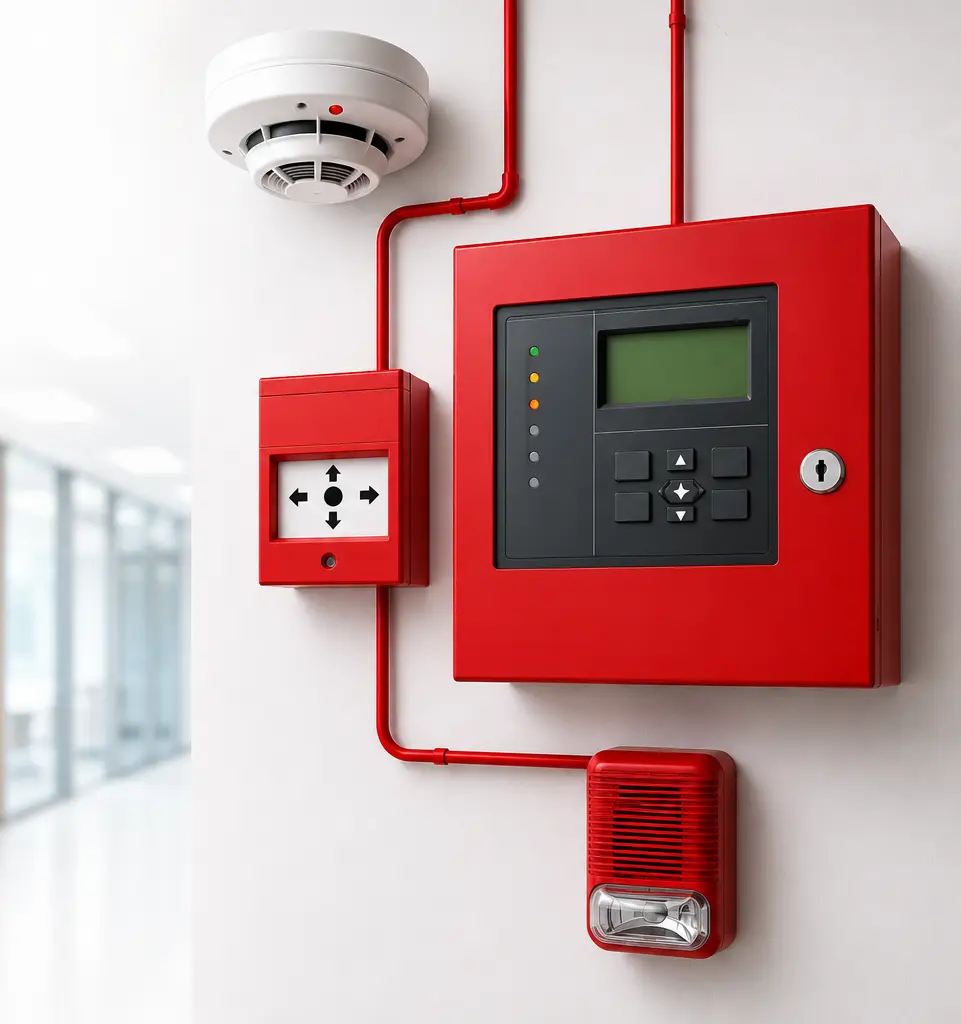
A fire alarm system operates through a continuous monitoring loop. Detection devices - smoke detectors, heat detectors, or manual call points - are wired back to a central fire alarm control panel (FACP). When a detector senses smoke or heat beyond its preset threshold, or when a manual call point is activated, it sends a signal to the panel. The panel processes the signal, confirms the alarm condition, and activates the warning devices - sounders, strobes, and voice evacuation speakers - throughout the building.
Types of Fire Alarm Systems We Install
The correct type of fire alarm system for your building depends on the building size, number of floors, occupancy type, risk classification, and applicable code requirements. We assess each project individually and recommend the most appropriate system - not the most expensive one.
Conventional Fire Alarm Systems
Conventional fire alarm systems divide a building into detection zones. Each zone covers a defined area - typically a floor, a section of a floor, or a specific room - and is wired as a single circuit back to the control panel. When any detector in a zone triggers, the panel displays which zone has activated but cannot identify the specific device.
Conventional systems are straightforward, cost-effective, and reliable. They are well-suited to smaller buildings, single-floor premises, low-risk warehouses, or buildings where zone-level identification is adequate for a first-response team to investigate quickly.
Analogue Addressable Fire Alarm Systems
In an addressable system, every detector, manual call point, sounder, and input/output module on the loop has a unique address programmed into the fire alarm control panel. When a device triggers, the panel displays the exact device, its location label, and its status - in real time. In a large multi-floor building, this means the panel can display "Smoke Detector - 3rd Floor Server Room, Detector 47" rather than simply "Zone 3 active."
Addressable systems reduce false alarm response time significantly, allow individual device sensitivity adjustment, provide event logging for maintenance records, and support integration with gas suppression systems, HVAC control, and building management systems. For any building above three floors or 1000 square metres, an addressable system is the correct choice.
Wireless Fire Alarm Systems
Wireless fire alarm systems use radio-frequency communication between detectors and the control panel - eliminating the need for extensive cabling. This makes wireless systems ideal for heritage buildings where cable routing is impractical, for temporary installations, or for retrofitting into occupied buildings where cable disruption is unacceptable.
Beam Detection Systems
Projected beam detectors use an infrared beam projected across a wide open space - such as an atrium, warehouse, or aircraft hangar. Smoke interrupting the beam triggers the alarm. A single beam detector can cover a horizontal distance of up to 100 metres, making beam detection far more cost-effective than dozens of point detectors in large open spaces.
Aspirating Smoke Detection (VESDA)
Aspirating systems actively draw air samples from the protected area through a network of sampling pipes and analyse them for trace smoke particles. VESDA detects fire at the pre-combustion stage - far earlier than any point detector. This is the correct solution for server rooms, data centres, telecom exchanges, and clean rooms where the earliest possible warning is critical.
Sounders and Visual Alarms
Sounders produce the audible alarm - at a minimum of 65 dB(A) at any point in the building, or 75 dB(A) in sleeping areas. Strobes provide visual warning for hearing-impaired occupants or noisy industrial environments where audible alarms may not be perceived. Combination sounder-strobe units are the most common solution.
Standards and Compliance
Every fire alarm system we design and install is engineered in strict compliance with national and international safety codes to ensure maximum reliability and seamless fire NOC approvals.
IS 2189 - Indian Standard for Fire Alarm Systems
IS 2189:2008 (Bureau of Indian Standards) is the primary standard governing the selection, installation, and maintenance of automatic fire detection and alarm systems in India. Key requirements include:
NBC 2016 Part 4 - National Building Code
The National Building Code of India 2016, Part 4 (Fire and Life Safety) specifies which building types and occupancies require a fire alarm system, the minimum system type (conventional vs addressable), and integration requirements with other fire safety systems. NBC Part 4 is the reference document used by Gujarat Fire & Emergency Services for fire NOC assessment.
NFPA 72 - Reference Standard
NFPA 72 (National Fire Alarm and Signaling Code, USA) is frequently referenced in India for large industrial projects, multinational client requirements, and data centre specifications. Where client specifications mandate NFPA 72 compliance, we design and document accordingly.
Industries and Applications
Different facilities present distinct fire risks and operational requirements. We match the system type and technology to the specific environment to ensure reliable protection and code compliance.
| Industry | System Type Typically Required | Key Consideration |
|---|---|---|
| Manufacturing / Factory | Addressable | Large area, dusty zones, multiple zones |
| Warehouse / Logistics | Conventional or Addressable | High ceiling beam detection, rack storage |
| Hospital | Addressable + Voice Evacuation | Phased evacuation, non-ambulatory occupants |
| Hotel | Addressable | In-room detection, guest evacuation, 24/7 operation |
| IT Park / Data Centre | Addressable + VESDA | Early warning, suppression integration |
| Educational Institution | Addressable | Large campus, multiple buildings |
| Shopping Mall | Addressable | High footfall, phased evacuation |
| Pharmaceutical Plant | Addressable + Ex-proof | Hazardous area classification |
| Residential (High-Rise) | Addressable | Floor-by-floor evacuation, NBC compliance |
| Cold Storage | Heat Detectors | Low temperature environment |
Design Considerations
A fire alarm system must be designed - not simply installed. Poor design is the single biggest cause of inadequate fire alarm performance. Our engineering team evaluates the following at every project:
NBC Classification
Building height, floor area, and occupancy classification per NBC 2016.
Ceiling Heights
Ceiling heights affect detector spacing requirements per the IS 2189 selection tables.
Airflow & HVAC
Airflow patterns and HVAC systems affect smoke movement and detector placement.
Hazardous Zones
Pharmaceutical, chemical, and paint areas require Ex-proof or Intrinsically Safe (IS) equipment.
Environmental Issues
Dusty, humid, or corrosive environments require specialized and ruggedized detector types.
Structural Obstructions
Beams, racks, and partitions affect detector field of view and coverage area.
System Integration
Outputs for gas suppression, HVAC shutdown, fire door release, and BMS interface.
Cable Routing
Fire-resistant cabling (FRLS/FP) routes for all critical circuits and alarm loops.
Power Supplies
Mains power and battery backup (minimum 24h standby + 30m alarm per IS 2189).
Installation Process - Step by Step
We follow a disciplined, rigorous engineering workflow to ensure every installation is fully documented, completely safe, and built to last.
Site Survey and Risk Assessment
Our engineers visit the site, review existing drawings, and assess occupancy, ceiling heights, hazardous areas, and integration requirements.
System Design and Drawing
We prepare zone drawings, detector layout drawings, cable routing plans, panel specification sheets, and battery calculations. Drawings are prepared in a format suitable for fire NOC submission.
Design Review and Approval
Drawings are submitted to the client, their consultant, or the fire authority for review and approval before work commences.
Material Procurement
Only approved brands and IS-marked or listed equipment are procured. We do not substitute specified brands or models without client written approval.
Cable Laying and Conduit Work
Fire-resistant cables (FRLS/FP rated) are laid through GI conduits or cable trays as per the approved routing plan.
Detector and Device Installation
Detectors, MCPs, sounders, and modules are installed at the designed positions and addressed (for addressable systems).
Panel Installation and Wiring
The FACP is installed, wired, and configured. Device addresses are programmed and zone maps are set up.
Pre-Commissioning Checks
Continuity tests, insulation resistance tests, and point-to-point checks are completed before power-up.
Testing and Commissioning
Each device is tested individually. Alarm sequences, integration outputs, and sounder levels are verified. Full commissioning records are documented.
Handover and Documentation
As-built drawings, commissioning reports, test records, and O&M manuals are handed to the client. Training is provided to the facility team.
Planning a new installation or taking over an existing system?
Talk to our engineers - free consultation, no obligation.
Testing & Commissioning
Commissioning is not an optional step - it is the point at which a system is proven to work. IS 2189 requires a full commissioning test before any fire alarm system is accepted and handed over. Our engineering team conducts rigorous diagnostic checks to verify system integrity.
A formal commissioning certificate signed by FSPL engineers is a mandatory prerequisite for obtaining and renewing your fire NOC in Gujarat.
Individual Detector Test
Smoke entry tests for smoke detectors and heat response tests for heat detectors.
Manual Call Point Test
All manual call points (MCPs) are activated and verified at the central panel.
Sounder Audibility Test
Sounder decibel (dB) levels are measured at all locations to ensure audibility.
System Integration Test
Verifying suppression triggers, HVAC shutdowns, door releases, and BMS outputs.
Battery Backup Test
Ensures a minimum of 24-hour standby and 30-minute alarm discharge capability.
Event Log Review
All diagnostic test events are recorded in the panel memory and verified.
Panel Display Accuracy
Cross-checking all device address labels and zone configurations on the panel.
Commissioning Report
A signed commissioning certificate is issued and countersigned by the client.
Fire Alarm Maintenance and AMC
A fire alarm system that is installed correctly but never maintained will fail when needed. Detectors accumulate dust, which either desensitises them (reducing sensitivity) or causes nuisance alarms (increasing sensitivity). Battery backup degrades. Panel faults accumulate unnoticed. IS 2189 requires periodic testing and maintenance with written records - these records are reviewed during fire NOC renewal inspections.
Our Annual Maintenance Contracts (AMC) cover quarterly or half-yearly preventive maintenance visits, full detector cleaning and sensitivity testing, battery checks, sounder verification, panel diagnostics, event log review, and a written service report after every visit. We provide AMC for all brands - including systems installed by other contractors.
Learn more about our Fire AMC services →What Our AMC Covers
Common Mistakes in Fire Alarm Installation
In our 20+ years of experience across Gujarat and India, these are the most common fire alarm installation failures we encounter when taking over systems from other contractors:
Detector Spacing
Detector spacing based on rule-of-thumb, not IS 2189 tables - Ceiling height directly affects maximum coverage area per detector. Many installations space detectors at a flat 7m x 7m grid regardless of ceiling height - incorrect and non-compliant.
Standard Cable Usage
Using standard electrical cable instead of FRLS/FP rated cable - In a fire, standard PVC cable burns through and disables the alarm at exactly the moment it is needed.
Insufficient Battery
Insufficient battery backup - IS 2189 requires 24-hour standby + 30-minute alarm. Many installations use undersized batteries that drain within 4–6 hours.
No Commissioning Docs
No commissioning documentation - Without a commissioning certificate and test records, the fire NOC submission is incomplete and the system has no baseline for future maintenance.
Unmonitored Panel
Panel installed in unmonitored location - Panels installed in locked rooms, basements, or areas not visible to security staff mean alarms go unnoticed.
No System Integration
No integration with building systems - Fire alarm systems in large buildings should trigger HVAC shutdown, elevator recall, and door release. Failing to integrate these reduces the effectiveness of the evacuation response.
Incorrect Zone Mapping
Detectors in wrong zones - Zones must follow logical evacuation routes and fire compartment boundaries - not convenience of cable routing.
Brands We Work With
We are authorised to supply and install fire alarm systems from the following manufacturers. All equipment is genuine, brand-authorised, and backed by local technical support:












Why Choose Fire Systems Pvt. Ltd.
When it comes to life safety, there is no room for compromise. Here is why industrial and commercial clients trust us with their fire alarm requirements:
Turnkey Capability
We design, supply, install, test, commission, and maintain. You deal with one responsible contractor throughout.
IS 2189 & NBC Compliance
All designs are code-compliant and documented for fire NOC submission.
Qualified Engineers
Our installations are supervised by trained fire safety engineers, not just electricians.
Brand Authorised
We source genuine equipment directly from authorised distributors. No grey-market or substitute products.
Documentation Focus
Complete as-built drawings, commissioning reports, and test records handed over at project completion.
Post-Installation Support
AMC, emergency breakdown response, and system upgrades.
Gujarat-Based
Local team for fast site response across Ahmedabad, Surat, Vadodara, Rajkot, Gandhinagar, and Anand.
Fire Alarm System Services Across Gujarat
We provide fire alarm system design, installation, and maintenance services across Gujarat. Our team is based in Ahmedabad and serves clients in Gandhinagar, Surat, Vadodara, Rajkot, Bhavnagar, Anand, Mehsana, Morbi, and across the state. We also execute fire alarm projects across India for clients with multi-location requirements.
| City | Services Available |
|---|---|
| Ahmedabad | Design Supply Installation AMC Emergency Service |
| Gandhinagar | Design Supply Installation AMC |
| Surat | Design Supply Installation AMC |
| Vadodara | Design Supply Installation AMC |
| Rajkot | Design Supply Installation |
| Bhavnagar | Installation AMC |
| Anand | Installation AMC |
| Pan Gujarat | Project-based turnkey |
Frequently Asked Questions
Have questions about fire alarm design, standards, or installation requirements? Find answers to commonly asked questions below:
IS 2189:2008 (Bureau of Indian Standards) - "Selection, Installation and Maintenance of Automatic Fire Detection and Alarm Systems" - is the primary Indian standard for fire alarm systems. It specifies detector spacing, manual call point placement, sounder levels, cable requirements, battery backup duration, and commissioning procedures. All fire alarm installations in India must comply with IS 2189 and NBC 2016 Part 4.
In a conventional system, detectors are grouped into zones - the panel identifies which zone has triggered but not the specific device. In an addressable system, every device has a unique address - the panel identifies the exact detector, its location, and its status. Addressable systems are more expensive but provide faster and more accurate alarm response, better false alarm management, and full event logging. For buildings above 3 floors or 1000 sq.m., addressable is the recommended type.
IS 2189 specifies detector spacing based on ceiling height. For ceilings up to 3.5m, a single photoelectric smoke detector covers a maximum of 37 sq.m. floor area (or 5.4m spacing from wall). For higher ceilings, the coverage area reduces. A room of 100 sq.m. with a 3m ceiling would typically require 3 smoke detectors. The exact count must be determined by design calculation, not rule-of-thumb.
Yes. Under the Gujarat Factories Act and NBC 2016 Part 4, a fire alarm system is mandatory for factories above a certain built-up area and occupancy. The exact threshold depends on the nature of the process and the building classification. Gujarat Fire & Emergency Services assess fire alarm adequacy as part of the fire NOC inspection.
A standard single-floor office (up to 500 sq.m.) can be commissioned within 3–5 working days. A multi-floor commercial building typically takes 2–4 weeks. A large industrial complex or hospital project is phased and may span 4–12 weeks depending on access and civil readiness.
Yes. In server rooms, UPS rooms, and other suppression-protected areas, the fire alarm system is the trigger for the gas suppression release. When a detector in the protected zone triggers, the fire alarm panel sends a signal to the suppression control panel, which initiates pre-discharge alarm and then releases the suppression agent after a time delay.
Contact us via the form below or call our office. We will arrange a free site survey at a time convenient to you. Following the survey, we provide a detailed itemised quotation with equipment list, design basis, compliance statement, and project schedule - typically within 3–5 working days.
Ready to Protect Your Facility?
We serve Ahmedabad, Surat, Vadodara, Rajkot, Gandhinagar, and all of Gujarat. Get a free site survey, detailed itemised quotation, and IS 2189 compliant design.
Request a Quote
Schedule a visit from our safety engineers for a detailed risk assessment and itemised project quote.
Response within 24 Hours · Zero Obligation