
VESDA Aspirating Smoke Detection System Installation - Ahmedabad, Gujarat & India
Fire Systems Pvt. Ltd. is a leading contractor for certified VESDA system installation in Gujarat. We design, install, test, commission, and maintain high-sensitivity aspirating smoke detection systems (ASD) for data centres, clean rooms, warehouse networks, MRI facilities, and critical commercial infrastructure across Ahmedabad, Gujarat, and all major hubs in India.
What Is a VESDA System?
VESDA (Very Early Smoke Detection Apparatus) is an aspirating smoke detection (ASD) technology that continuously draws air samples from the protected environment through a network of sampling pipes and analyses them for trace smoke particles using a highly sensitive laser-based detector. Unlike conventional point detectors that passively wait for smoke to drift to the detector, VESDA actively samples the air - providing detection at the pre-combustion stage, far earlier than any conventional smoke detector.
The term VESDA is a registered trademark of Xtralis (now part of Honeywell). Equivalent aspirating smoke detection systems include FAAST (Fire Alarm Aspiration Sensing Technology) by System Sensor and Securiton ASD series. In common industry usage in India, all aspirating smoke detection systems are referred to as VESDA.
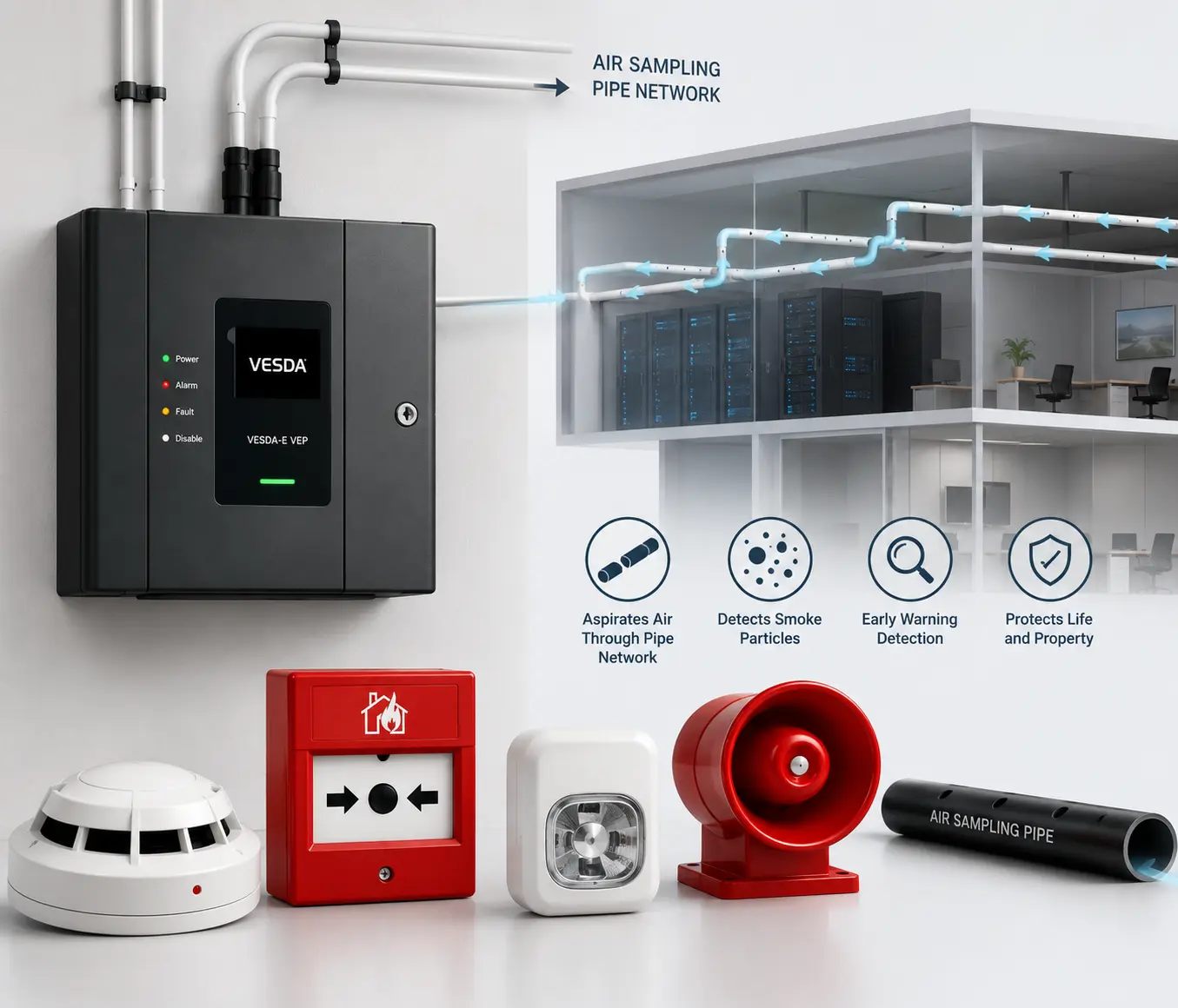
Key Comparison: Conventional Smoke Detector vs. VESDA
Understand the fundamental technical differences between standard point-type smoke detection systems and aspirating smoke detection (ASD) systems.
| Feature | Conventional Smoke Detector | VESDA / Aspirating Detector |
|---|---|---|
| Detection method | Passive - smoke must reach detector | Active - air drawn continuously to detector |
| Detection stage | Visible smoke | Pre-combustion / trace smoke |
| Detection sensitivity | Standard | Up to 1000x more sensitive |
| Response time | Minutes after visible smoke | Minutes to hours before visible smoke |
| Coverage per unit | 1 detector, ~37 sq.m. | 1 unit, up to 2000 sq.m. |
| False alarm resistance | Standard | High - four-stage alarm threshold |
| Maintenance | Detector replacement | Pipe cleaning, filter replacement |
| Suitable for | General building areas | Critical / high-value environments |
| Cost | Low | High |
| IS 2189 compliance | Yes | Yes (as alternative detection technology) |
How VESDA Works
A VESDA (Very Early Warning Smoke Detection) system operates by actively sampling air from the protected zone and processing it in a highly sensitive optical analysis chamber. Here is the step-by-step workflow of how it detects fire signs before combustion occurs:
Four-Stage Alarm Architecture
A key advantage of VESDA technology is its multi-level alarm capabilities. Instead of a simple binary on/off response, the system provides early stages of warning to allow investigation and correction before suppression activation is triggered.
| Threshold | Typical Response | Purpose |
|---|---|---|
| Alert | Engineering notification only | Earliest warning - investigate before escalating |
| Action | Increased monitoring, local warning | Smoke concentration rising - take action |
| Fire 1 | Local alarm, notify key personnel | Confirmed smoke - initiate investigation and alert |
| Fire 2 | Full building fire alarm, suppression trigger | Confirmed fire - full emergency response |
Where VESDA Is Required or Recommended
Very Early Warning Smoke Detection is essential in facilities where even a small or smouldering fire can lead to catastrophic hardware damage, chemical contamination, data loss, or high-value asset destruction.
VESDA vs Standard Smoke Detection - When to Use Which
VESDA is not a replacement for standard smoke detection in general building areas - it is a specialized technology for critical environments where the earliest possible warning has very high value.
A server room that generates ₹50 lakh/hour of revenue if operational justifies VESDA investment. A standard office meeting room does not. We advise clients honestly on where VESDA is genuinely justified and where a well-designed addressable system is adequate.
Systems We Install
We partner with global leaders in aspirating smoke detection technology to deliver certified, fully compliant installations tailored to your facility's requirements.
| Brand | System | Key Features |
|---|---|---|
| System Sensor | FAAST (Fire Alarm Aspiration Sensing Technology) | Four-stage alarm, capillary sampling, wide coverage |
| Xtralis (Honeywell) | VESDA-E VEA, VEP, VES, VEI | Range from room-level to enterprise multi-zone |
| Securiton | ASD 535 | Swiss-engineered, pharmaceutical-grade sensitivity |
Installation Considerations
A successful aspirating smoke detection system relies on rigorous engineering design and precise installation standards. We consider these critical parameters for every project:
Sampling Pipe Layout
Layout must ensure the maximum transport time (time for air to travel from the furthest sampling point to the detector) does not exceed 90 seconds, in compliance with NFPA 72 and manufacturer guidelines.
Pipe Material Selection
Dedicated, high-quality red ABS or CPVC pipes must be used for the sampling network; standard electrical PVC conduit is not acceptable under fire safety standards.
Sampling Hole Spacing
Spacing and diameters of each sampling port are calculated using specialized flow-modeling software (like ASPIRE) to ensure balanced airflow from all points.
Filter Maintenance
VESDA filter cartridges require periodic checking and replacement to maintain detection chamber sensitivity and prevent dust-related false alarms.
Raised Floor Grid
When monitoring underfloor voids, sampling pipes are installed in a clean grid pattern (typically 1.5–2m spacing) directly beneath cable trays.
System Integration
VESDA detector outputs interface with the main addressable fire alarm panel using monitor modules. Multiple relays are configured to trigger gas suppression systems, alert the BMS, and shut down local HVAC air handling units.
Frequently Asked Questions - VESDA Systems
Have questions about aspirating smoke detection, sensitivity levels, or compliance? Find answers below:
VESDA stands for Very Early Smoke Detection Apparatus. It is a registered trademark of Xtralis (now Honeywell) for their aspirating smoke detection product range. The term is commonly used in India to refer to all aspirating smoke detection systems regardless of brand.
VESDA can detect smoke at concentrations as low as 0.005% obscuration per metre - approximately 1000 times more sensitive than a standard photoelectric smoke detector. In practical terms, this means VESDA can detect the thermal degradation of electronic components (the first sign of electrical fire) minutes to hours before visible smoke is generated, compared to a conventional detector that only triggers once there is significant visible smoke.
VESDA is not explicitly mandated for server rooms in IS 2189 or NBC 2016, but is strongly recommended by data centre design standards (Uptime Institute, TIA-942) and required by many insurance underwriters for Tier III and Tier IV data centres. For any server room above a certain value threshold, VESDA is the industry-standard solution.
VESDA systems require annual cleaning of sampling pipes (blowing through with compressed air), filter cartridge replacement (typically annually or based on contamination level), sensitivity calibration check, and functional test of all alarm thresholds. Maintenance is more intensive than standard detectors but is essential to maintain the sensitivity advantage.
Coverage depends on the model. A single VESDA VEA unit (Xtralis) can monitor up to 2000 sq.m. using a multi-pipe sampling network. Larger data centres use multiple units networked together into a monitored system.
Ready to Protect Your Critical Infrastructure?
We serve Ahmedabad, Surat, Vadodara, Rajkot, Gandhinagar, and all of Gujarat. Get a free site survey, detailed model calculations, and an IS 2189 compliant layout.
Request a Site Survey
Schedule a visit from our certified safety engineers for a customized VESDA piping layout and project quotation.
Response within 24 Hours · Zero Obligation